The December issue of Rogue Magazine carries with it a one page comic strip depicting a short history of Philippine Comics. In it, the writer asserts that Carlo J. Caparas was responsible for the rise of independent comics like my Elmer and Carlo Vergara’s ZsaZsa Zaturnnah.
This is absolutely, any utterly UNTRUE.
Carlo J. Caparas had NOTHING to do with the rise of the Philippine Independent Komiks Industry. NOTHING AT ALL. I don’t know where this writer even got this idea because it is just absolutely RIDICULOUS.
To further validate this, I’ve started to put together, with the help of the many independent komiks creators stretching back to 1993, a comprehensive timeline of significant events and publishing history of the new Pinoy Komiks, where one can see clearly this was all happening without Carlo J. Caparas.
The main purpose of the timeline however, aside from setting the record straight, is to document and archive and to fully cement in history, the accomplishments of modern day Filipino komiks creators.
If you are a Filipino komiks creator who have published comics here in the Philippines from 1993 onward, please send me an email at gerryalanguilan at yahoo dot com with the subject line “Komiks Timeline”. Please include the Title, Date of Publication, Publisher and list of creators.
I will be posting this timeline sometime early December.
Here is the response from Rogue Magazine:
http://www.facebook.com/notes/rogue-magazine/a-letter-from-budjette-tan-on-pinoy-komiks/10151101256362109
I applaud Budjette’s efforts to reach out to Rogue, and while it’s good that we got some kind of response, I feel it’s not good enough. Hopefully, there will be an erratum in the next issue.

Monday, November 26, 2012
Sunday, November 25, 2012
“Komiks Is Dead” is a DEAD Issue (UPDATED)
An article I wrote came out in the Philippine Daily Inquirer not too long ago. I will be posting the complete unedited article after my post below. I almost declined writing the article because I was too busy, but I immediately realized the opportunity to talk positively about the state of Philippine comics.
TWENTY YEARS into the life of the Philippine Independent Comics Industry, I would think it would be ridiculous if there were still clueless people around thinking komiks was dead. I mean, really? This is a debate that has raged in various forums, message boards and blogs over the last 10 years, but I think time has proven that it has never really died. That Komiks is very much alive. To me that debate is over. Komiks IS alive. Everyone should really just accept that as a fact, because it IS a fact.
If anyone else wants to waste time and saliva to debate that, well, you can do that on your own because I, and a ton of other folks are MOVING ON. Talk to the fucking wall till you are blue in the face. As far as I’m concerned, anyone who wants to waste time talking about that has got nothing of substance and nothing of importance at all to say to me. And I will not waste a single minute (apart from writing this blog entry) of my precious creative time debating something that is completely and utterly moot. If I did, I’ll just be depriving myself of time in creating MORE COMIC BOOKS.
I think anyone who even says Komiks is dead today is, I’m sure, completely aware of the truth, malamang nangaasar na lang. Or maybe they’re just absolutely ignorant and clueless. Maybe even Bitter Ocampo? Who knows? I really don’t care. They’re now all in my ignore list.
Anyone creating comics, and anyone who is a reader of our comics don’t even have to think about this. Right now we’re just more concerned about creating better comics, and finding more ways to get our comic books into the hands of readers.
So yeah, let’s just not waste anymore time engaging these people guys. It’s just a waste of time. Let’s just do our comics!
As to why I even bother posting about this at all if I say I just want to ignore and say I don’t care… well, I guess just I’m the kind of person who wants these people to know WHY I’m ignoring them. Telling them why they’re being ignored is almost as important as ignoring them. It helps explain my motivations and it prevents them from having any stupid misrepresentations of my silence. I’ve ignored them for years, and to help explain why, this hopefully gives a definite answer.
**********************
Ten Years of KOMIKON
Last October 27. 2012, the eighth Philippine Comics Convention or Komikon was held at the Bayanihan Center in Pasig. EIGHTH you say? You bet! But isn’t Pinoy Komiks dead? Breaking news, son. It never died!
Let me take you back some two decades ago to 1993. The once giant Philippine comics industry was on the wane, with decades old komiks companies closing their doors to publishing comics one by one. But at the same time, something strange was happening. Without any venues to showcase their work, talented young comic book fans started creating their own comic books. They photocopied the pages, stapled them together, and sold the comics themselves. Some even went further by actually going to the printing press and have multiple copies printed. Where did they get the money? Most likely some of them had jobs, some of them probably saved up for it, and some probably borrowed money from their parents. Whatever the case, what resulted was the birth of a unique Filipino independent comics industry driven by young people who created, distributed and sold their own comic books.
Even as early as 1994, comics shows were already beginning to be held starting with a mini convention held at the Robinson’s Galleria where enthusiastic comics creators like Budjette Tan, Arnold Arre, David Hontiveros, Gilbert Monsanto, myself and many more gathered for the first time. It began an explosion of self published comic books of all kinds: Comics 101, Exodus, Wasted, P-Noize, Shadow, Memento Mori, Flashpoint, Archon, Dhahmpyr, Indigo Valley, Scions, Tatooed, Pagan Press, Angel Ace, and so many more.
There were quite a few shows that followed there and at other malls, each event growing bigger than the last. 2003 saw the very first San Pablo City Comics Festival organized by the Komikero Artists Group, which signalled the growth of such events outside of Metro Manila.
Along the way, remarkable self published comic books started to appear including Arnold Arre’s four-issue Mythology Class and Trip To Tagaytay, Carlo Vergara’s Ang Kagila-Gilalas na Pakikipagsapalaran ni ZsaZsa Zaturnna, Volumes 1 and 2., Budjette Tan and Arnold Arre’s Batch 72, and the anthology books Siglo: Freedom and Siglo: Passion.
In 2005, a group of particularly dedicated comic book fans and creators called The Artists’ Den decided to organize the first Komikon and hold it at the University of the Philippines, Bahay ng Alumni. Within a few years, the venue had become too small to accommodate the growing number of comics creators and fans. The event moved several times from Star Mall in Mandaluyong, to the Megatrade Hall in Megamall, and eventually to their current home, the Bayanihan Center in Pasig.
Komikon is now held twice a year, once in the summer called “Summer Komikon”, and the main Komikon held around the end of the year.
That the growth of Komikon and that of the independent comics industry go hand in hand is worth taking time to consider. Most of these creators create, sell and distribute their own comics. With no huge distribution arm at their disposal, they sell their comics at every place they are capable of reaching. They can sell at the various comic book stores across Manila including Comic Odyssey which has always been supportive of local comics, and of course, they take full advantage of the local comic book conventions, wherever and whenever they are held.
Big publishers have noted the success of this growing industry and have taken it upon themselves to select some of the more popular and successful titles and publish them, affording the comic books a larger audience than what they would normally achieve.
Adarna has taken on Arnold Arre’s works and have published After Eden, Visprint has published both Budjette Tan and Kajo Baldisimo’s Trese as well as Carlo Vergara’s collected edition of ZsaZsa Zaturnnah, and National Bookstore has published Skyworld by Mervin Ignacio and Ian Sta, Maria, as well as Elmer, 2nd Edition by yours truly.
With the big publishers getting into the act, it necessitated the a third spinoff convention of the Komikon called the “Indieket”, which emphasizes and showcases the very roots of the independent comics industry, the self published comic book makers who photocopy and print their own comics. That the Komikon has held such a spinoff event shows how they staunchly want to stay true to their roots, but at the same time being open to growth and maturity. While these small groups are still a very big part of the main conventions, I think that it’s only fitting and right that they have a show all their own.
At the Komikon last October, more new and better comic books were released by an even younger generation of creators as the venue struggled to accommodate the sheer number of people in attendance.
Across the country even more comics conventions are being held. There have been conventions held in Baguio, Bikol, Cebu, San Pablo City, Los Baños, and this year sees the very first Iloilo Comics Convention in December. In January next year there’s possibly another one in General Santos City.
Pinoy komiks is dead? You must be crazy!
TWENTY YEARS into the life of the Philippine Independent Comics Industry, I would think it would be ridiculous if there were still clueless people around thinking komiks was dead. I mean, really? This is a debate that has raged in various forums, message boards and blogs over the last 10 years, but I think time has proven that it has never really died. That Komiks is very much alive. To me that debate is over. Komiks IS alive. Everyone should really just accept that as a fact, because it IS a fact.
If anyone else wants to waste time and saliva to debate that, well, you can do that on your own because I, and a ton of other folks are MOVING ON. Talk to the fucking wall till you are blue in the face. As far as I’m concerned, anyone who wants to waste time talking about that has got nothing of substance and nothing of importance at all to say to me. And I will not waste a single minute (apart from writing this blog entry) of my precious creative time debating something that is completely and utterly moot. If I did, I’ll just be depriving myself of time in creating MORE COMIC BOOKS.
I think anyone who even says Komiks is dead today is, I’m sure, completely aware of the truth, malamang nangaasar na lang. Or maybe they’re just absolutely ignorant and clueless. Maybe even Bitter Ocampo? Who knows? I really don’t care. They’re now all in my ignore list.
Anyone creating comics, and anyone who is a reader of our comics don’t even have to think about this. Right now we’re just more concerned about creating better comics, and finding more ways to get our comic books into the hands of readers.
So yeah, let’s just not waste anymore time engaging these people guys. It’s just a waste of time. Let’s just do our comics!
As to why I even bother posting about this at all if I say I just want to ignore and say I don’t care… well, I guess just I’m the kind of person who wants these people to know WHY I’m ignoring them. Telling them why they’re being ignored is almost as important as ignoring them. It helps explain my motivations and it prevents them from having any stupid misrepresentations of my silence. I’ve ignored them for years, and to help explain why, this hopefully gives a definite answer.
**********************
Ten Years of KOMIKON
Last October 27. 2012, the eighth Philippine Comics Convention or Komikon was held at the Bayanihan Center in Pasig. EIGHTH you say? You bet! But isn’t Pinoy Komiks dead? Breaking news, son. It never died!
Let me take you back some two decades ago to 1993. The once giant Philippine comics industry was on the wane, with decades old komiks companies closing their doors to publishing comics one by one. But at the same time, something strange was happening. Without any venues to showcase their work, talented young comic book fans started creating their own comic books. They photocopied the pages, stapled them together, and sold the comics themselves. Some even went further by actually going to the printing press and have multiple copies printed. Where did they get the money? Most likely some of them had jobs, some of them probably saved up for it, and some probably borrowed money from their parents. Whatever the case, what resulted was the birth of a unique Filipino independent comics industry driven by young people who created, distributed and sold their own comic books.
Even as early as 1994, comics shows were already beginning to be held starting with a mini convention held at the Robinson’s Galleria where enthusiastic comics creators like Budjette Tan, Arnold Arre, David Hontiveros, Gilbert Monsanto, myself and many more gathered for the first time. It began an explosion of self published comic books of all kinds: Comics 101, Exodus, Wasted, P-Noize, Shadow, Memento Mori, Flashpoint, Archon, Dhahmpyr, Indigo Valley, Scions, Tatooed, Pagan Press, Angel Ace, and so many more.
There were quite a few shows that followed there and at other malls, each event growing bigger than the last. 2003 saw the very first San Pablo City Comics Festival organized by the Komikero Artists Group, which signalled the growth of such events outside of Metro Manila.
Along the way, remarkable self published comic books started to appear including Arnold Arre’s four-issue Mythology Class and Trip To Tagaytay, Carlo Vergara’s Ang Kagila-Gilalas na Pakikipagsapalaran ni ZsaZsa Zaturnna, Volumes 1 and 2., Budjette Tan and Arnold Arre’s Batch 72, and the anthology books Siglo: Freedom and Siglo: Passion.
In 2005, a group of particularly dedicated comic book fans and creators called The Artists’ Den decided to organize the first Komikon and hold it at the University of the Philippines, Bahay ng Alumni. Within a few years, the venue had become too small to accommodate the growing number of comics creators and fans. The event moved several times from Star Mall in Mandaluyong, to the Megatrade Hall in Megamall, and eventually to their current home, the Bayanihan Center in Pasig.
Komikon is now held twice a year, once in the summer called “Summer Komikon”, and the main Komikon held around the end of the year.
That the growth of Komikon and that of the independent comics industry go hand in hand is worth taking time to consider. Most of these creators create, sell and distribute their own comics. With no huge distribution arm at their disposal, they sell their comics at every place they are capable of reaching. They can sell at the various comic book stores across Manila including Comic Odyssey which has always been supportive of local comics, and of course, they take full advantage of the local comic book conventions, wherever and whenever they are held.
Big publishers have noted the success of this growing industry and have taken it upon themselves to select some of the more popular and successful titles and publish them, affording the comic books a larger audience than what they would normally achieve.
Adarna has taken on Arnold Arre’s works and have published After Eden, Visprint has published both Budjette Tan and Kajo Baldisimo’s Trese as well as Carlo Vergara’s collected edition of ZsaZsa Zaturnnah, and National Bookstore has published Skyworld by Mervin Ignacio and Ian Sta, Maria, as well as Elmer, 2nd Edition by yours truly.
With the big publishers getting into the act, it necessitated the a third spinoff convention of the Komikon called the “Indieket”, which emphasizes and showcases the very roots of the independent comics industry, the self published comic book makers who photocopy and print their own comics. That the Komikon has held such a spinoff event shows how they staunchly want to stay true to their roots, but at the same time being open to growth and maturity. While these small groups are still a very big part of the main conventions, I think that it’s only fitting and right that they have a show all their own.
At the Komikon last October, more new and better comic books were released by an even younger generation of creators as the venue struggled to accommodate the sheer number of people in attendance.
Across the country even more comics conventions are being held. There have been conventions held in Baguio, Bikol, Cebu, San Pablo City, Los Baños, and this year sees the very first Iloilo Comics Convention in December. In January next year there’s possibly another one in General Santos City.
Pinoy komiks is dead? You must be crazy!
Sunday, November 4, 2012
Saving the Komiks Industry Should Never be the Goal

Beyond Komikon: Young creators bring komiks to life
http://www.gmanetwork.com/news/story/280371/lifestyle/literature/beyond-komikon-young-creators-bring-komiks-to-life
Just a few years ago, many people were stumped on how to revive the Komiks industry. Here on this blog, I said that we should stop dreaming of ever expecting komiks to go back to the old golden days where komiks sold in the millions and it was everywhere to be found. Sadly, unless someone with millions of cash invests in publishing and distributing komiks nationwide, those days are never gonna come again.
But that doesn’t mean Philippine comics is DEAD.
Never believe any idiot who will tell you that today. Pinoy Komiks is alive and well. Their number may pale in comparison to how it was in the old days, but they’re there, nevertheless. And it is an industry that is growing with each passing year. The resurgence of Philippine made comics was not some brainchild of some guy who thought, “HEY, I’m going to revive the komiks industry!” It was not planned by a committee or any komiks congress. It didn’t come from legislation, directive or any kind of help at all from the Philippine government.
It came from a generation of comic book fans who love comics, and who love creating comics.
Do you think most of those who create comics in that link above do it primarily for the money? Because they thought comics was going to make them rich? Hardly! These comics are coming out because these guys are passionate about comics. Passionate about creating their own comics. I’m sure none of them had the primary goal of “REVIVING THE KOMIKS INDUSTY”. They just wanted to create comics. And so many creators wanted to create comics that a lot of new comics are created every passing year. And every passing year, the quality of these comics are improving and improving.
And along the way, the Komiks Industry was revived without people even realizing it. And that is how it should be. Never make it a goal. Just create comics, GOOD comics, and these things will follow.
I remember one idiot who said that komiks cannot be revived through love. Hey, look at me. This is me, LAUGHING AT YOU.
Over the years I’ve had so many detractors and naysayers. It’s all right to have an opposing opinion of course, I don’t mind that. But I’ve also come to realize that it’s probably better to ignore people who are out to do nothing but put me down. It’s no use debating them, it’s no use talking to them. Whatever I say, they would say anything back just to contradict me. Yeah, ignoring these people did me lots of good and guess what?
I was eventually proven right.

Sunday, December 4, 2011
The 3rd San Pablo City Comics Festival Photos and Video
Waking up Saturday morning and seeing the sun shine all my worries about the day disappeared. Normally, I’m a worrier, but I just let it go. Whatever happens will happen. If it rains, whatever, I’ll just sing. lalala. It did drizzle a bit, but thankfully it was short and in the end, I think we all had a really nice time!
 Organizers Jonas Diego and Johnny Danganan organize the chairs.
Komiks Illustrator Jun Lofamia
 The Great Manix Abrera’s fans arrived first!
 Comic Odyssey
 Alexis Ravana, winner of the art contest, Young Adults category.
 My mom at the art exhibit
 Ner Pedrina, Rommel Estanislao, Silent Sanctum, Freely Abrigo
 Mel Casipit, Jon Zamar, Sherry Zamar and Ariel Atienza
 Gio Paredes and the just released Kalayaan TPB!
 Jun Lofamia
Danny Acuña sketches.
 Architect and Komiks Illustrator Marivi Hilos-Nepomuceno and special guest Pol Medina
 Komiks Veterans Jun Lofamia and Danny Acuña were mobbed!
 My parents
 Marvel superstar artist Carlo Pagulayan and Marivi
  With Pol Medina, Kajo Baldisimo and Carlo judging the art contest.
Acoustic music from local San Pablo talents Walk Me Home.
With much thanks to the Ultimart Shopping Plaza and the San Pablo Chapter of the United Architects of the Philippines for their generous support of the event!
Thanks also to Comic Odyssey, Fun House (Ultimart), Expressions (Ultimart), and Electro Magnetic Tentacle for their generous donations!
More Photos from My Facebook
Sunday, September 12, 2010
Komikero Publishing’s Survival Plan in the Digital Age
From September 13 to 14 will be a huge conference in Quezon City on the “Future of the Book” organized by the National Book Development Board (NBDB), Filipinas Heritage Library and the Vibal Foundation. It’s going to be held at the Ayala Techno Hub in Commonwealth Avenue.
I was supposed to be a speaker on DAY 2 where I will discuss how self publishers can survive in the Digital Age. Unfortunately, circumstances beyond my control have forced me to bow out of the conference. It was a difficult decision to make because there were plenty of things I wanted to say, specially in a program that made it seem that going digital was a forgone conclusion. I felt it was an obligation for me to offer a dissenting voice.
Nevertheless, below is the complete transcript of the talk that I would have had.
**********************
Komikero Publishing’s Survival Plan in the Digital Age
by Gerry Alanguilan
I have been self publishing my own comic books for the last 12 years. I started out as many comics people are starting out today….by making multiple photocopies of our work and then sell them ourselves. There are many ways to do this. We can deliver copies to sympathetic stores and comic book stores, sell them at local comics conventions, or sell them via mail.
In recent years I decided to legally establish my own publishing company, the sole purpose of which is to publish work that I wrote and/or drew. Instead of photocopy I went to an actual printing press. My output is sparse, with just one or two comic books a year since 2006. It is by no means something I can exclusively make a living out of, but I can honestly say that through selling the book myself, each publication has been quite profitable in comparison to the money I spend in printing them.
As early as the year 2000, I have been encountering furious discussions on the viability of online comics as a commercial enterprise. Over the years, the discussions have grown to include downloadable comics for reading on portable readers like the Kindle or the iPad. Advocates of digital comics have been quite vocal, I have discovered, and I am very sure there are many of you are here in this audience right now.
I have heard all the arguments. While it’s cool to have an actual copy of a book in your hands to see and smell, such attachments to tangibility is a characteristic that only the increasingly old may have. The younger generation are growing up without actual books so reading online or on a portable gadget won’t be a problem for them. In fact, entire libraries can fit into one of these gadgets giving more space in your house, and in your luggage when you travel. Now this all makes perfect sense, and I’m not here to argue the point.
As a self publisher in this increasingly digital age, how can I possibly survive? I have several answers for this.
Take note that I am speaking only for myself, as publisher and owner of what I consider to be a specialty publishing company, releasing only one or two books a year. What I say may not be applicable to bigger publishers and my experience cannot speak for those that are.
I honestly and truly believe that a third world country like the Philippines won’t be doing away with print books and publications anytime within the next 10 years. Because most of us, if not all of us here in this conference are most likely online, and we are in touch with the biggest and latest news in terms of publishing from abroad, I think we may be getting a skewed notion that all THAT is applicable here in the Philippines as well. Countries like the US or Japan can afford to go digital because majority of their population can afford it. Here in the Philippines, does anyone actually believe that the typical Pedro on the street who can barely make enough money to buy newspapers will be able to buy an iPad or any similar gadget, no matter how less expensive it may be, within the next 10 years, or even 15 years? I seriously doubt it.
Print publications here in the Philippines still has a long way to go yet, I believe. I am 42 years old now. Personally, I doubt that digital will overtake print in this country even within my lifetime. So why would I waste the time I have left in this world chasing after a market that will never be truly widespread until I die? It does not make any business sense.
So as a publisher, I will continue to have my comics printed, and will resist any suggestion to do otherwise.
Of course, I could be wrong. I could be devastatingly wrong. In 15 years, I might be out there, pan handling like a bum in the middle of Quiapo as the executives, students, cops, fortune tellers, florists, evangelists, dried fish vendors and takatak boys blissfully pass by with their iPads and Kindles.
But what is publication but a risk? As publishers, we are ALL taking a risk with the books we publish. As a publisher in the Philippines, to be specific… as a small time specialty Publisher… it is with print comics that I place my bets.
Let us say I was proven completely wrong and the Philippines has indeed gone digital in the near future (if not already) I will nevertheless still continue to have my comic books printed. I will still continue to do it, frustrating the naysayers no end until they scratch their heads and exasperatedly exclaim, “Why don’t you just die?!”
I won’t be doing this out of spite (perhaps partly I will), but only because I love print books. I love making them. And in the future, I really believe a few people will still feel the same way about books as I do.
Indeed, since I, and perhaps a couple of other people will be the only ones left doing it, our work will then become much more valuable. Imagine it. In an almost completely digital world, only a few rare individuals still create their comic books in print. We become a novelty, that’s true, but even among the young generation and the generations that will follow, there will be those who will be looking for the tangible thing. As many things from the old world fade and disappear, I believe the more we as human beings will value them. I’d like to think that I’ll be that TV repairman who still makes housecalls. I’ll be that crotchety old man whose job it is to repair typewriters. I’ll be the old school hippie selling vinyl records. I’ll be that curmudgeonly old shoemaker on the far side of town who will still measure your feet to make you shoes. I’ll be that weirdo who still writes letters by hand and sends them through the post office, no matter how expensive it is. I’ll be that grumpy old man in San Pablo City who draws on paper and prints his comics.
I am, by no means, a complete luddite. I have uploaded a few of my comics online and I have used the Internet considerably to promote my publications. In fact, online promotion has been a major part of my marketing strategy.
WASTED is the title of a comic book that I created from 1994 to 1996. It has gone through several editions in print, the first edition coming out in 1998 through Alamat Comics. In 2000 it was serialized for several months in Pulp Magazine. In 2002, Pulp Magazine published another compiled edition. A few years later, Wasted went out of print. In 2007, I decided to upload Wasted completely online, including a DVD-like commentary for each page at Webcomicsnation.com. It allowed a lot more people to read it, specially those from abroad.
But then, a strange thing happened. I still get letters and emails to this day from people looking for copies of Wasted. I always point out that they can read the entire thing for FREE online. The reaction is almost unanimous and immediate: No, we want to buy the print edition. There is not a comics convention that goes by (and believe it or not, we have something like six or seven of those a year here in the Philippines) that people don’t ask me for a copy of Wasted. The demand has grown so much that I’ve put it in the front burner of my company’s publishing schedule.
My other book ELMER was published through my own Komikero Publishing in 4 issues from 2006 to 2008. The first issue very quicky sold out. And when it did, I digitized it and uploaded it online as both as one HTML file where you can read it in one go, and as a downloadable Comic Book Reader file. FOR FREE. My purpose for doing so was to encourage people to buy the rest of the series in print, and the compiled edition which came out in 2009.
To further entice people to buy the printed comics, I collaborated with my wife’s paper crafting company to create a limited edition ELMER Box Sets which included a hardbound hand crafted copy of Elmer 1-4, photographs, facsimile of some of the objects found in the story, one piece of original artwork, and a certificate of authenticity. These are things that cannot be reproduced digitally, but can be created simply by hand. The minute I made the announcement on my blog about the existence of these box sets, I never had the opportunity to sell them at our local conventions because reservations for it came pouring in through email and quickly sold out.
Inspired by the success of the Elmer Box Sets, I am now currently planning what the WASTED special edition set will contain when I publish a new edition of it next year.
The next book I will publish is entitled “The Marvelous Adventures of the Amazing Doctor Rizal”. To encourage people to buy the print edition, I will be taking another risk and print it in a large format, with a width of 9 and half inches and height of 12 inches. Each copy will be hardcover, full color and printed on matte paper. Unless one has a large vertical monitor, the reader will not be able to fully appreciate the comic book in a digital format.
As a print publisher, I use the latest technologies to promote the work I do that’s available in print. I think it’s the perfect compromise between my personal sensibilities towards print publications, and the undeniable impact that the digital age has brought.
In spite of what I said earlier, I well and truly believe that digital books will and can exist side by side with print books and that both will flourish, and sometimes even complement each other. Not all people are created the same. Not all people will go digital, and not all people will be reading books in print. As we go slowly towards that day, I sincerely believe that technology, as well as us human beings, will find our proper places naturally through evolution and experimentation, and we will find there is a place for everyone, print and digital books alike.
I was supposed to be a speaker on DAY 2 where I will discuss how self publishers can survive in the Digital Age. Unfortunately, circumstances beyond my control have forced me to bow out of the conference. It was a difficult decision to make because there were plenty of things I wanted to say, specially in a program that made it seem that going digital was a forgone conclusion. I felt it was an obligation for me to offer a dissenting voice.
Nevertheless, below is the complete transcript of the talk that I would have had.
**********************
Komikero Publishing’s Survival Plan in the Digital Age
by Gerry Alanguilan
I have been self publishing my own comic books for the last 12 years. I started out as many comics people are starting out today….by making multiple photocopies of our work and then sell them ourselves. There are many ways to do this. We can deliver copies to sympathetic stores and comic book stores, sell them at local comics conventions, or sell them via mail.
In recent years I decided to legally establish my own publishing company, the sole purpose of which is to publish work that I wrote and/or drew. Instead of photocopy I went to an actual printing press. My output is sparse, with just one or two comic books a year since 2006. It is by no means something I can exclusively make a living out of, but I can honestly say that through selling the book myself, each publication has been quite profitable in comparison to the money I spend in printing them.
As early as the year 2000, I have been encountering furious discussions on the viability of online comics as a commercial enterprise. Over the years, the discussions have grown to include downloadable comics for reading on portable readers like the Kindle or the iPad. Advocates of digital comics have been quite vocal, I have discovered, and I am very sure there are many of you are here in this audience right now.
I have heard all the arguments. While it’s cool to have an actual copy of a book in your hands to see and smell, such attachments to tangibility is a characteristic that only the increasingly old may have. The younger generation are growing up without actual books so reading online or on a portable gadget won’t be a problem for them. In fact, entire libraries can fit into one of these gadgets giving more space in your house, and in your luggage when you travel. Now this all makes perfect sense, and I’m not here to argue the point.
As a self publisher in this increasingly digital age, how can I possibly survive? I have several answers for this.
Take note that I am speaking only for myself, as publisher and owner of what I consider to be a specialty publishing company, releasing only one or two books a year. What I say may not be applicable to bigger publishers and my experience cannot speak for those that are.
I honestly and truly believe that a third world country like the Philippines won’t be doing away with print books and publications anytime within the next 10 years. Because most of us, if not all of us here in this conference are most likely online, and we are in touch with the biggest and latest news in terms of publishing from abroad, I think we may be getting a skewed notion that all THAT is applicable here in the Philippines as well. Countries like the US or Japan can afford to go digital because majority of their population can afford it. Here in the Philippines, does anyone actually believe that the typical Pedro on the street who can barely make enough money to buy newspapers will be able to buy an iPad or any similar gadget, no matter how less expensive it may be, within the next 10 years, or even 15 years? I seriously doubt it.
Print publications here in the Philippines still has a long way to go yet, I believe. I am 42 years old now. Personally, I doubt that digital will overtake print in this country even within my lifetime. So why would I waste the time I have left in this world chasing after a market that will never be truly widespread until I die? It does not make any business sense.
So as a publisher, I will continue to have my comics printed, and will resist any suggestion to do otherwise.
Of course, I could be wrong. I could be devastatingly wrong. In 15 years, I might be out there, pan handling like a bum in the middle of Quiapo as the executives, students, cops, fortune tellers, florists, evangelists, dried fish vendors and takatak boys blissfully pass by with their iPads and Kindles.
But what is publication but a risk? As publishers, we are ALL taking a risk with the books we publish. As a publisher in the Philippines, to be specific… as a small time specialty Publisher… it is with print comics that I place my bets.
Let us say I was proven completely wrong and the Philippines has indeed gone digital in the near future (if not already) I will nevertheless still continue to have my comic books printed. I will still continue to do it, frustrating the naysayers no end until they scratch their heads and exasperatedly exclaim, “Why don’t you just die?!”
I won’t be doing this out of spite (perhaps partly I will), but only because I love print books. I love making them. And in the future, I really believe a few people will still feel the same way about books as I do.
Indeed, since I, and perhaps a couple of other people will be the only ones left doing it, our work will then become much more valuable. Imagine it. In an almost completely digital world, only a few rare individuals still create their comic books in print. We become a novelty, that’s true, but even among the young generation and the generations that will follow, there will be those who will be looking for the tangible thing. As many things from the old world fade and disappear, I believe the more we as human beings will value them. I’d like to think that I’ll be that TV repairman who still makes housecalls. I’ll be that crotchety old man whose job it is to repair typewriters. I’ll be the old school hippie selling vinyl records. I’ll be that curmudgeonly old shoemaker on the far side of town who will still measure your feet to make you shoes. I’ll be that weirdo who still writes letters by hand and sends them through the post office, no matter how expensive it is. I’ll be that grumpy old man in San Pablo City who draws on paper and prints his comics.
I am, by no means, a complete luddite. I have uploaded a few of my comics online and I have used the Internet considerably to promote my publications. In fact, online promotion has been a major part of my marketing strategy.
WASTED is the title of a comic book that I created from 1994 to 1996. It has gone through several editions in print, the first edition coming out in 1998 through Alamat Comics. In 2000 it was serialized for several months in Pulp Magazine. In 2002, Pulp Magazine published another compiled edition. A few years later, Wasted went out of print. In 2007, I decided to upload Wasted completely online, including a DVD-like commentary for each page at Webcomicsnation.com. It allowed a lot more people to read it, specially those from abroad.
But then, a strange thing happened. I still get letters and emails to this day from people looking for copies of Wasted. I always point out that they can read the entire thing for FREE online. The reaction is almost unanimous and immediate: No, we want to buy the print edition. There is not a comics convention that goes by (and believe it or not, we have something like six or seven of those a year here in the Philippines) that people don’t ask me for a copy of Wasted. The demand has grown so much that I’ve put it in the front burner of my company’s publishing schedule.
My other book ELMER was published through my own Komikero Publishing in 4 issues from 2006 to 2008. The first issue very quicky sold out. And when it did, I digitized it and uploaded it online as both as one HTML file where you can read it in one go, and as a downloadable Comic Book Reader file. FOR FREE. My purpose for doing so was to encourage people to buy the rest of the series in print, and the compiled edition which came out in 2009.
To further entice people to buy the printed comics, I collaborated with my wife’s paper crafting company to create a limited edition ELMER Box Sets which included a hardbound hand crafted copy of Elmer 1-4, photographs, facsimile of some of the objects found in the story, one piece of original artwork, and a certificate of authenticity. These are things that cannot be reproduced digitally, but can be created simply by hand. The minute I made the announcement on my blog about the existence of these box sets, I never had the opportunity to sell them at our local conventions because reservations for it came pouring in through email and quickly sold out.
Inspired by the success of the Elmer Box Sets, I am now currently planning what the WASTED special edition set will contain when I publish a new edition of it next year.
The next book I will publish is entitled “The Marvelous Adventures of the Amazing Doctor Rizal”. To encourage people to buy the print edition, I will be taking another risk and print it in a large format, with a width of 9 and half inches and height of 12 inches. Each copy will be hardcover, full color and printed on matte paper. Unless one has a large vertical monitor, the reader will not be able to fully appreciate the comic book in a digital format.
As a print publisher, I use the latest technologies to promote the work I do that’s available in print. I think it’s the perfect compromise between my personal sensibilities towards print publications, and the undeniable impact that the digital age has brought.
In spite of what I said earlier, I well and truly believe that digital books will and can exist side by side with print books and that both will flourish, and sometimes even complement each other. Not all people are created the same. Not all people will go digital, and not all people will be reading books in print. As we go slowly towards that day, I sincerely believe that technology, as well as us human beings, will find our proper places naturally through evolution and experimentation, and we will find there is a place for everyone, print and digital books alike.
Monday, December 7, 2009
The Second San Pablo Comics Festival in Pictures
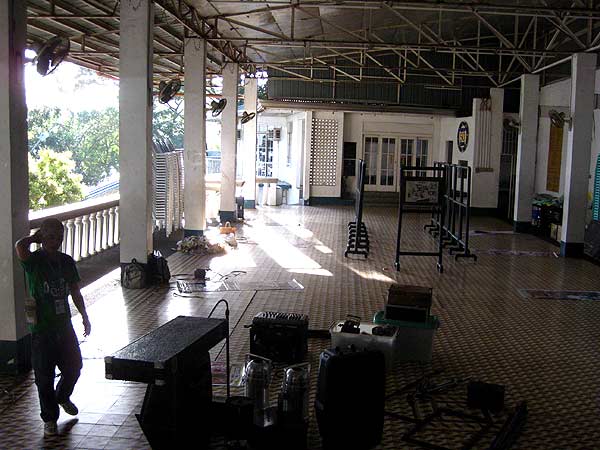
We had the venue, the Lion’s Club of San Pablo, for only ONE day. So we had planned to bring all the tables, chairs, mobile, tarpaulins, decorations, exhibits and exhibit panels early in the day before the doors opened at 10am, and pack them all up by 6:00pm.
We were at the venue at 6:30am. We planned to be there at 6 but we’re sleepy heads. The caretaker of the place was a sleepy head as well because we were knocking on the gates long before she opened it. As soon as she sleepily staggered to open the gate for us, off we went.

The tarpaulins and exhibit panels were courtesy of Davies Paints and the United Architects of the Philippines, San Pablo Chapter. The UAP is celebrating National Architecture Week, and they chose to co-sponsor the event. They can only sponsor an event if members of the sponsored group/event had architects in it, and there were THREE of us: myself, Ilyn and Arlan Esmeña. All of us card-carrying members of UAP San Pablo.

Dressing up the stage

Setting up the exhibits

Early birds Andrew Villar and Rod Espinosa help set up the exhibits. Thanks guys!

Pregnant Komikera Edjee setting up exhibits

The United Architects of the Philippines, San Pablo Chapter

Ilyn at the Komikero Publishing table

Pinoy Komiks Rebyu fan, Maya Salas

Bayan Knights!

Heubert Michael, Stephen Segovia and Harvey Tolibao at the Comic Odyssey table

The Great Manix Abrera

Kajo Baldisimo of TRESE

KIDS!

Christina, from Germany!

My dad browsing a copy of “Where Bold Stars Go To Die”, much to my horror. I have yet to tell them about this comic book. Well, they know now.

We offer our appreciation for Mr. Hugo “Boboy” Yonzon for his contribution to Philippine comics.

Grand Prize contest winner.


John Becaro at the Freedom Wall

Ed Tadeo. Dramatic.

The Cast of Characters

With Rod Espinosa

With Kajo Baldisimo and Manix Abrera
 The Komikero Artists Group, recreating the poster. See you all next year!
Photos from My Facebook
Photos from Randy Valiente
Photos from Hazel Chua
Wednesday, November 4, 2009
Electrical Conundrum
Electricity has been very unstable recently due to the weather. I used to have a UPS (Uninterrupted Power Supply) attached to my computer, but since that thing gave out, all that’s standing between my computer and the naked socket is a voltage regulator.
But since Voltage Regulators just, well, regulate, I’ve had to buy a new UPS so that I can protect my already struggling 5 year old computer from shutting off when the power flickers.
Ok, so this is my set up. From the naked socket a voltage regulator is plugged. The UPS is then plugged to the voltage regulator. The computer is then plugged to the UPS. Should be fine right? I test it by closing the voltage regulator. The UPS kicks and in and beeps. But the computer is unaffected! It’s still on! I turn the voltage regulator back on.
Now the electricity flickers again for a split second. It shouldn’t affect my computer right? But inexplicably, the computer shuts off. The UPS acts like nothing happened. It didn’t flash any battery lights nor did it make a sound.
OK you techie guys out there. How is this electrical conundrum possible? Because I’m ready to take a sledgehammer and break things here.
But since Voltage Regulators just, well, regulate, I’ve had to buy a new UPS so that I can protect my already struggling 5 year old computer from shutting off when the power flickers.
Ok, so this is my set up. From the naked socket a voltage regulator is plugged. The UPS is then plugged to the voltage regulator. The computer is then plugged to the UPS. Should be fine right? I test it by closing the voltage regulator. The UPS kicks and in and beeps. But the computer is unaffected! It’s still on! I turn the voltage regulator back on.
Now the electricity flickers again for a split second. It shouldn’t affect my computer right? But inexplicably, the computer shuts off. The UPS acts like nothing happened. It didn’t flash any battery lights nor did it make a sound.
OK you techie guys out there. How is this electrical conundrum possible? Because I’m ready to take a sledgehammer and break things here.
Subscribe to:
Posts (Atom)